|
PERU, BOLIVIA, ECUADOR & BACK TO PERU!30 September99--Cusco, Peru It is roughly 9:40pm and we just completed several hours
of, can you believe it, homework (o en Espanol, tarea). While doing so, our studies were preempted on several
occasions by less than efficient conversation, in Spanish, with members of the
family in whose home we are staying.
We will wake up tomorrow and begin our morning Spanish
lessons promptly at 8:00am, finishing for the morning at 11:00am.
We will then, as we have every day since we have been here, wander and
explore the city (perhaps admiring the amazing Inca stonework that grace Intik’ijullo
and Hatun Rumiyoc), ultimately picking a restaurant where we will enjoy a 3
course lunch that will cost us not much more than $4.00.
After lunch, we will probably go to La Plaza de Armas, the central
square of Cusco, and select a park bench upon which we will do our morning’s
homework assignment for our afternoon Spanish lessons.
Our afternoon lessons commence at 3:00pm at Los Ninos
Hotel and end
at 5:00pm. Following our
afternoon lessons, we will explore the city yet again, as she and her people
continue to reveal to us hidden and not so hidden charms, before turning, yet
again, to homework. At around
7:00, we will turn to a restaurant or café for dinner, a meal which will in
all likelihood cost us no more than $6.00 (and often less, as last night’s 2
course dinner cost us a total of 6 soles, or the equivalent, roughly, of
$2.00).
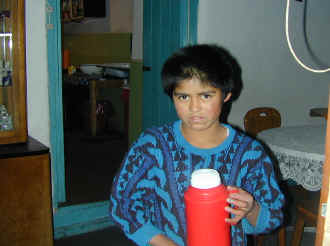
When we return to our room for the evening, we may be greeted by Lucita (one of at least 3 children who live in this home; we seem to see new people each day) who, with her short black hair, intensely brown skin, and bashful, never-ending, smile, cannot help but capture your heart. We will do our best to communicate with Lucita in Spanish, although we will have some difficulty because Lucita, who was recently adopted by this family, knows little Spanish; rather, her native tongue is Quechua, the language of the Inca people. My how our lives have changed.
Lucita.
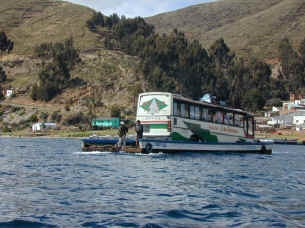
2 October 99--Cusco, Peru We returned to our room today to discover that I blew up the battery charger that recharges the batteries for our digital camera. I had plugged it into the wall without a voltage converter. With 220 volts pulsing through its little 110 volt veins, the little guy didn't have a chance. Stupid mistake. Indeed, I'm surprised the whole house didn't go black. I have a voltage converter with me (actually 2); I just got lazy and forget. I have gotten use to both the AC adopter for both our laptop and our camera, each of which has a voltage converter built in. Oh well. 8 October 99--Ollantaytambo, Peru My first case of intestinal turbulence. 3 trips to el bano in one hour. Not fun, but to be expected from time to time. I actually dipped into the prescriptions for the first time--2 doses of Cipro--and order has been restored, as I rule my kingdom once more. Aren't you glad I shared this with you? 10 October 99--Cusco, Peru We are getting ready to upload our web site so I am feverishly trying to add some content. I've been rather derelict in my travelogue responsibilities, but understand, of course, that I am trying to learn a second language and have little time for the niceties of journal entries. Actually, the Spanish lesson thing has been interesting. It has been very difficult getting used to being a "student" again, and it's proving to be rather difficult. I really need to study more but time does not always allow that. Kelly and I also try to speak only Spanish for a good part of the day, but it is so easy to slip back into good ole comfortable English. All in all, it is rather humbling being dumb again, not knowing anything. I think that language skills are a right side (or maybe left side) of the brain sort of thing; a side of my brain that has laid dormant for the past 7 years while I practiced law. In any event, we just returned from a week of taking Spanish lessons on the road. We had a pretty amazing time. It was a great way to keep up with our Spanish lessons, yet at the same time see more of this wonderful country. And interestingly, as we were getting ready to return here to Cusco, it actually felt like we were coming home from a week away. Odd. We plan on hiking the Inca Trail to Machu Picchu starting this Tuesday, culminating with our descent into Machu Picchu, the "lost city of the Inca's", four days later. Described as one of the world's great treks, we are pretty excited to get going. Thereafter, we are not quite sure what we will be doing. The downside (if you can call it that) of the flexibility of itinerary that we have is that we have tough choices still to make. We have roughly one month left before we return, briefly, to the States, and in that time we are trying to decide what to do. We are considering going to Quito Ecuador, and then on to the Galapagos Islands. The problem with that option is that this time of year it is, we understand, quite rainy in the Galapagos and, far more importantly, getting there and around is very expensive. For money reasons alone, perhaps we will save the Galapagos Islands for a vacation we will take in the future once we return to working lives and paying jobs. We just keep reminding ourselves that we can't see it all, and that saving money will, in the long run, allow us to see more. We are also considering going to the Amazon basin--the jungle/rainforest--of Peru. Again, finances may prove to be an impediment, as travel to that part of the country, which is very isolated, is also very expensive. But the allure of the jungle is powerful. We'll see. What we will most likely do is travel through the South of Peru, visiting places such as Arequipa, the Colca Canyon (the world's second deepest canyon, twice as deep as the Grand Canyon, and home to the Andean Condor), Puno, and Lake Titicaca (the world's highest navigable lake), before heading into Bolivia for a brief spell. We'll let you know. Whatever we end up doing, we know its going to be great. 20 October 1999--Amantani Island, Lake Titicaca, Peru Whoever said money cannot buy happiness was a genius. We are here in a place without plumbing or electricity, where the outhouses are made of adobe bricks (fashioned from mud and straw), and where subsistence farming seems to carry the day. The family with whom we are staying can fairly be said, from our spoiled, Western standards, to be living in absolute squalor. Yet the constant joy and happiness of the inhabitants of this small island is inescapable. Children playing with other children, mothers joking with daughters, brothers clowning with sisters. It is all rather powerful, not to mention perspective enhancing. 23 October 1999--La Paz, Bolivia I am really pleased that we decided to come to Bolivia and La Paz. For a while there, we threatened never to leave Peru; there is that much to do there. We have also decided that, notwithstanding the reasons not to, that we will visit the Galapagos. We are so relatively close, and the Galapagos truly is one of those amazing, got to see, sort of places, that we simply cannot miss them. Plus, we have talked to so many travelers that have returned from there and, to a person, they all say that we absolutely have to go. Enough said. La Paz has, in a mere 2 days, revealed itself to be an amazing, vibrant, multi-faceted city; one to which I definitely want to return. Indeed, Bolivia has so much to offer that not only do I want, at some point, to return to La Paz, but I definitely want to explore more of Bolivia's country. What strikes me about La Paz most is several things. For one, the energy level is amazingly high. This early in our travels, the comparison that currently strikes me as the most apt is a comparison to the various "China Towns" I have visited. Whether in San Francisco, Toronto, or New York, what I have always enjoyed immensely about the various China Towns is the vibrancy and energy of the streets. Walking through such places, it seems that everyone is out and about at the same time, either buying or selling. Same energy vibe here in La Paz; everyone is out buying and/or selling. At times, the city seems like one big market, with street stands on every sidewalk, every corner, every street's edge. Here, as with the other parts of South America we have visited, there simply are no stores bigger than a small room. No supermarkets, Home Depots, Wal-Marts, or other convenient, one-stop, shopping locations. If you want something, hit the streets! What is also amazing about La Paz is its fascinating, and proportionate, mix of old and new, both with respect to its people and its design. For instance, this is the first city that we have been in on this trip where you'll see a large number of people dressed in sharp business attire, toting mobile phones--just like the States. Yet on that same street, you'll see Quechuan women toting babies in thier mantas (blankets drapped over their backs), while other indigenous people sell brujo (shaman or witch doctor) accessories, such as dried llama fetuses, on the corner. Continue on that same street, and you may soon pass out of the chaotic market areas, to a section of the street where teenagers are gathering, in Western clothing, gossiping and hanging out outside a large, modern movie theatre. Fascinating. For instance, this evening we walked around a more affluent section of town; an area which, as we strolled, could have easily been mistaken for New York or Boston. Modern buildings, stylistic designs, nice landscaping. And great restaurants. We dined tonight at an elegant restaurant that would have absolutely been at home in either Buckead or SoHo, yet this extravagant meal for 4, with wine, cost us less than $20.00 a couple. 24 October 1999--Juliaca, Peru It's roughly 6:30pm and we feel great, having just had a hot shower after having arrived at our destination for the evening. It has been a long day of travel that saw us awakening at 6:00am in La Paz, Bolivia, boarding an 8:00am bus, and traveling ever since. Specifically, here is what our travel day was like: Segment 1: 8:00am bus ride from La Paz to the Straits of Tiquina, on Lake Titicaca. Roughly 2 hours. Cost per person for bus ride all the way to Copacabana, Bolivia (on the shores of Lake Titicaca, very close to the Peruvian border): 13 Bolivianos each, or just over $2.00usd (roughly 5.9 Bolivianos = $1.00usd). Segment 2: Disembark the bus at the Straits of Tiquina for the ferry ride over. The bus rides across separately from its passengers on its own wooden barge. There are those of us who are rather surprised not to see it sink. The passengers pay 1.20 Bolivianos (roughly $0.20usd) each to cross the straits on what appears, to the casual observer, a dangerously over-crowded small boat. As we cross, there are those of us who are rather relieved that the boat does not sink.
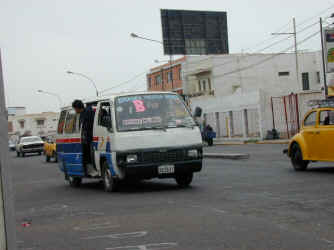
Segment 3: Safely across the rather lovely Straits, we reboard the bus and continue on to Copacabana, arriving there at roughly 11:00-11:30am. With the help of the driver, we collect our packs from the roof of the bus, and saunter to our new favorite restaurant, La Leyenda, right on the beach front shores of Lake Titicaca. We had eaten there when we were previously in Copacobana, a scant 3 days earlier, and had specifically planned the stop in Copacabana to enjoy the tasty food once more. Segment 4: Satiated with yet another fine dining experience at La Leynda (costing us 24 Bolivianos, or roughly $4usd), we head to the Plaza Sucre to find a collectivo heading to Kasani, the Bolivian border with Peru. "Collectivos" are critical to the transportation system in South America, and are essentially vans that, somehow or another, cram as many people as will fit into them (our personal record was a van filled with 27 people, of which Kelly and I were but 2; thankfully, the first stop roughly 20 minutes into the ride brought the number of people to the much more reasonable number of 17) before departing on their designated route. Very cheap, and very local, as many tourists opt for an experience less earthy, less crowded, and less aromatic. Incidentally, collectivos, and their make shift seats bolted to wooden slats running the length of the floorboards, are better suited to the typical, relatively short, Peruvian or Bolivian stature, and not to persons who are 6'2". But I digress. This collectivo ride is a mere 20 minutes, which is rougly the length of our wait as we wait for other passengers to fill up the collectivo to allow it to leave. Mercifully, capacity on this small van is a mere 7 people. Cost per person is 2.50 Bolivianos.
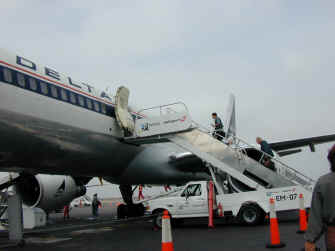
Segment 5: In the small pueblo of Kasani, we head to the Bolivian immigration office for our departure stamp. Afterwords, we cross by foot the roughly 100 yards into Peru, stopping at Peruvian immigration for entry stamps and our tourist cards, allowing us each 90 days in Peru. The entire process is quick and painless. Emerging from Peruvian immigration, we decide to splurge on a moto-taxi (essentially, a motorcycle rigged with a small, attached, carriage, which can carry 2-3 passengers) for a non-collectivo ride into the border town of Yunguyo. The ride takes rougly 10 minutes, and costs us 2 soles, or roughly $0.60 (3.34 soles = $1.00usd). Segment 6: In Yunguyo, Peru, we are walking toward the Plaza at which collectivos gather for the common trip to Puno, Peru, a journey of 2 hours. As we make our way there, an empty collectivo drives by, asking if we are going to Puno. We are, and ask them how much and when are they leaving. With respect to departure time, there are two competing concerns. On the one hand, if you are the first passengers committed to the collectivo, you may have a lengthy wait until other passengers join you and the van is full. On the other hand, choice of seat is critical, and a wait at the outset may repay you ten-fold with increased comfort during the ride. In this particular instance, we get the best of all worlds. We are the first passengers in, and they are leaving immediately. Apparently they need to get back to Puno quickly, and if they can pick up some passengers, all the better. For price, they offer 4 soles, but we know the going rate to be 3.50 soles and they quickly agree. The packs go on the roof and we are off. Spread out for the first time in a collectivo, we enjoy the comfort while it lasts. Gradually, however, the collectivo fills to its usual over capacity as passengers wave it down at roadside and board for the ride to Puno. Discomfort is, however, relative, and we finally get to Puno at, roughly, 2:45-3:00pm. Segment 7: In Puno, which also sits on the shores of Lake Titicaca (this lake is enormous), we immediately look for yet another collectivo to Juliaca, which is an hour away and where we will catch a flight tomorrow for Lima, before continuing on to Ecuador and the Galapagos Islands. As we look for transport, we notice what appears to be a chaotic, angry mob, desparately trying to board a small bus. Indeed, we notice some people, discontent with boarding in a conventional manner, climbing through windows, while others pass their children through windows to serve as living, breathing, place holders. We are so happy that we don't have to deal with that madness that, momentarily, we fail to notice that the destination of that bus is, in fact, Juliaca! We walk over and get in line with the others waiting for future buses, as the buses to Juliaca on this Sunday afternoon arrive and depart with frequency, in order, no doubt, to keep up with the large demand for transport to that destination. In line, we again notice that we are the only non-locals that wish to board this bus. We briefly consider a taxi to Juliaca, which would cost us 30 soles, or $10usd, but in contrast to the 2.30 soles it will cost us to ride the bus, we cannot justify the expense. Plus, we are here to experience the country and the people; what better way than battling with those same people for the scarce resource of seats to Juliaca. Resolved, we devise a plan for boarding. Initially, we decide that Kelly will board, saving a seat for me by whatever means necessary, while I tend to the loading of the packs on the roof. Concerned that such a plan is doomed for failure, we then decide that we will board with our packs, secure seats, and, if necessary, ride with our packs in our lap. After roughly 30 minutes of waiting for the bus that will be ours, it arrives and we are able to quickly board and secure seats. Compared to the small seats, our packs are enormous and overwhelming. Thankfully, the driver's assistant notices as much and, no doubt concerned that these packs inside the bus means fewer passengers can be crammed inside as well, asks that we pass our packs through the window (there is simply no getting back to the door of the bus, given the mass of humanity that stands between us and it), whereupon they are properly loaded as luggage. Mission accomplished, as we enjoy the comfort of seating while many stand around us. After 1 hour of travel, we finally arrive to our ultimate destination, Juliaca, Peru, at about 5:00pm. We have been traveling for over 9 hours, with spectacular scenery throughout, at a total cost of roughly $8.60. While the day was long and tiring, we wouldn't trade this day for anything--certainly not the antiseptic experience of a tourist bus direct from La Paz or a quick and efficient, but expensive, plane ride. That having been said, it is great to finally be clean. and comfortable. It feels good to be alive. No joke. Not to be overdramatic, but this evening we had the fun of an emergency landing on our flight from Lima to Tumbes, a town in northern Peru on the border with Ecuador. Close to half way through the flight, a flight attendant was called to the cockpit. The somewhat nervous flier that I am, which is only heightened when traveling on third world airlines, I noticed this immediately. Shortly thereafter, the flight attendants hurriedly, and harriedly, collected all the cups from the passengers. Being a big believer in looking to the flight attendants whenever there is cause for concern in my admittedly over-active mind, I looked for reassurance that all was well in the calm demeanor of these trained, seasoned, professionals. Sadly, both Kelly and I perceptively saw fear, concern, and fluster. Not exactly what I had hoped to see. The captain then came on the intercom to announce we were returning to Lima, as the plane was experiencing mechanical difficulty. Next to us sat a doctor, and we asked whether the captain had said more, or provided additional explanation which escaped our language skills. The doctor confirmed that the captain had not said more. Where, I asked myself, were the calming words of assurance...the Spanish equivalents of "normal," "not to worry," "customary," and "we are not going to die in a fiery death spiral to the ground," all would have been much appreciated. The flight attendants continued to be flustered. Then, the pleasant touch of illuminating, in day-glow fashion, each of the exit signs added to the ambiance of dread. As a final, nice, touch, the attendants than walked down the aisle turning on each and every reading light. No doubt to provide pitifully supplemental illumination to the flames that would quickly engulf the cabin as we smashed into the ground. Kelly, ever the optimist, who earlier has been assuring me we would be fine, briefly began to hyper-ventilate. Boy, was this fun. The doctor next to us pulled his emergency information card, and reviewed it nervously. The prayers were coming fast and furiously. Kelly and I reviewed the necessity of getting to the emergency exit no matter what. This was not the time for "niceness," of which Kelly is quite prone. While we did not believe, deep-down, that we were going to crash, it was also not lost on us that this was as good an opportunity as any. We noticeably began our descent, and soon the ground was visible. So far, so good. The plane was still under seemingly perfect control, and the engines sounded normal. Nevertheless, the doctor next to us assumed the crash position, his head between his knees, his hands braced against the seat in front of him. This, too, made us feel swell. And then, thankfully, it was over. We were on the ground, having landed safely, on our way to the gate. The emergency vehicles gathered on the tarmac were wonderfully unnecessary. What was the problem? We do not know, as no explanation was provided to us nor available. We quickly began reviewing bus schedules. 27 October 99--Guayaquill, Ecuador The emergency Landing in Lima was not enough. The bus strike in Ecuador was not enough. The difficulty of getting from Machala, Ecuador to Guayaquill, Ecuador, a journey which ordinarily would take 4 hours by any one of the hourly buses that ply that route, was not enough. Getting ripped off by the TAME airline office, paying $334 for a plane ticket to the Galapagos that should have cost $290 was not enough. The near Kafkaesque experience of cashing traveler's checks into the currency of a country whose largest bill is roughly equivalent to $3, necessitating our departure from the bank with ridiculously conspicuous bricks of cash, was not enough. On top of all these pleasant happenings, I had to go and sprain, severely, my ankle. Not to worry, as "it's all part of the experience, Russ." Actually, I'm rather pleased that all I did was sprain it--I was rather concerned that it may have been broken, or that more serious damage done to the ligaments. Happily, Dr. Plaza has confirmed it is a mere sprain. Getting to the Galapagos is proving to be an exercise in commitment and resolve. I trust, however, that it will be worth it. 31 October 99--Galapagos Islands, Ecuador Today was truly magical--snorkeling in extremely close quarters with sea turtles. In a cove formed of volcanic rock, we snorkeled in a large basin with dozens of these magnificent, graceful, creatures. "Once in a lifetime" is a well worn cliché, but entirely appropriate in this instance. 3 November 99--Porta Ayaro, Galapagos Islands, Ecuador Our fantasy aboard the Samba has come to a close. Six unbelievable days and nights. We truly are saddened to leave, as it means departing from all of our new friends--the crew and the fellow passengers--as well as our life of luxury, personal service, and plentiful food. The comparative hardship of ordinary budget travel begins anew. This day also underscores what is perhaps most difficult about this type of travel. Namely, leaving quickly forged, yet meaningful, friendships behind, often with no real prospect of ever seeing, talking, or communicating with such persons ever again. Saying bye to friends, in most cases forever, isn't very much fun. 8 November 99--Lima, Peru We have just enjoyed a whirl-wind day in Lima. Happy to report that, notwithstanding all the negative press from guidebooks and some travelers, we find it to be rather pleasant. Arrived this morning after a night bus ride of roughly 8 hours from Trujillo, Peru. Slept remarkably well. It may have had something to do with the fact that on this bus ride, unlike other night bus rides, no one was sleeping in the aisle next to me, stinking out the joint, or insisting on using my leg as a pillow/head-rest (all in spite of my repeated blows to her/his head--it was rather androgynous--with my knee). One notable activity today was our trip to the Museo de Oro--Lima's famed gold museum. Housing a world famous collection of highly traveled (to other museums world-wide) gold artifacts, among other things, it comes highly recommended from both guidebooks and fellow travelers. Often the contrarians, we were thoroughly unimpressed, particularly with the 20 soles admission ($6-7), which was absolutely outrageous in the light of our travel to date. Joked with each other about how we had made a big mistake in coming, as we each imitated the sound of a flushing toilet...with our money inside. Curiously, and perhaps sadly, the visit was salvaged for these road fatigued travelers by the portion of the exhibit devoted to Mochican artifacts. The Moches predated the Incas, and as it turns out, in addition to being excellent goldsmiths, were quite fond of pottery with phallic and other similar themes. We giggle like school children at many of them, which really are quite funny if not, at times, somewhat disturbing. Instantly, we feel better. 9 November 99--Lima, Peru We sit here in the Lima airport with mixed emotions--very sad that we are leaving South America, as it has been a great 7 weeks. At the same time, we are excited to see our friends in the States. It is interesting how travel, and meeting other travelers (particularly from countries other than the USA), changes your perspective in all sorts of ways. One way is that you realize how short 7 weeks of travel is--sounds odd to a country that is used to taking only 2 weeks of vacation a year, but 7 weeks really is very short. While we saw a great deal of Peru, and a little of Bolivia and Ecuador, in certain respects it seems as though we barely scratched the surface. There is still so much to see in Peru alone. We already know we will return.
CLICK THE FLAG TO TRAVEL WITH RICH NEXT TO THE GOOD
OL' U.S. OF A.
|
|
2 Go Maps / 2 Go Actual Itinerary / 2 Go Photos / 2 Go Home Page
PLEASE E-MAIL US. . . WE WOULD LOVE 2 HEAR FROM YOU!
©1999-2001 Kelly and Rich Willis. All rights reserved. |